Conservation Biology E-Portfolio
North Carolina Wetlands at Risk
A long-form portfolio on ecological function, legal narrowing, and the conservation consequences of weakened wetland protection in North Carolina.
Policy
Clean Water Act
North Carolina
This page is designed as an editorial field guide: part policy analysis, part ecological argument, and part visual case for why wetlands should not be treated as disposable margins on the landscape.
Navigation
How to use this portfolio
01
Historical background
From wetland conversion and drainage to the legal architecture that once supported broader protection.
02
Federal and state narrowing
How Sackett and North Carolina policy choices widened the gap between ecology and regulation.
03
Ecological stakes
Why wetlands matter for flood buffering, biodiversity, water quality, and landscape resilience.
04
Solutions and outlook
What responses remain plausible through state action, mapping, restoration, and public engagement.
Executive summary
Abstract
North Carolina’s wetlands sit at the intersection of biodiversity, flood control, water quality, and environmental governance. Yet the legal geography that protects them has narrowed. Following the U.S. Supreme Court’s 2023 decision in Sackett v. EPA, the federal definition of which wetlands qualify for Clean Water Act protection became more limited, emphasizing a continuous surface connection to jurisdictional waters.1 In the same year, North Carolina revised its state definition of wetlands to align with that narrower standard, reducing protection for isolated and other non-404-jurisdictional wetlands.2 A later NCDEQ coastal strategy document summarized the consequence starkly: according to EPA, roughly 30,000 isolated wetlands in the state no longer have protection.3
This portfolio argues that wetland loss in North Carolina is not only an ecological issue but also a regulatory and political one. It traces the historical role of the Clean Water Act, explains the policy shifts that now expose wetlands to greater risk, examines the ecological value of wetland systems to wildlife and human communities, and evaluates realistic conservation responses. The site concludes that protecting North Carolina wetlands requires stronger state-level safeguards, improved mapping and monitoring, and a more explicit recognition that so-called isolated wetlands remain deeply important within broader hydrologic and ecological landscapes.
Argument map
How this portfolio makes its case
1. Ecological value
Wetlands support biodiversity, hydrology, flood buffering, and water quality across North Carolina landscapes.
2. Regulatory mismatch
Legal definitions do not always track ecological function, especially for isolated or seasonally connected systems.
3. Political consequence
Federal narrowing and state alignment together create a more vulnerable landscape for wetlands and communities.
4. Conservation response
Protection, mapping, restoration, and public visibility become more important once the federal floor contracts.
Introduction
Why this issue matters
Wetlands are often treated as marginal landscapes: wet, inconvenient, and waiting to be filled, drained, or built over. Conservation biology tells a different story. Wetlands perform regulatory work for whole ecosystems and human communities alike. They store floodwater, improve water quality, retain sediment and nutrients, support amphibians, birds, fish, and invertebrates, and buffer downstream systems from ecological shock. In North Carolina, wetlands occur from the coast to the mountains, and NCDEQ now describes the state as having at least 4.2 million acres of wetlands, or roughly 14% of its land area.4
The central conservation problem is therefore not simply that wetlands are ecologically important; it is that legal definitions and administrative thresholds do not always track ecological function. Wetlands that appear disconnected on a regulatory map may still matter to regional hydrology, biodiversity, flood resilience, and water quality. The controversy over North Carolina wetlands is a case study in that mismatch.
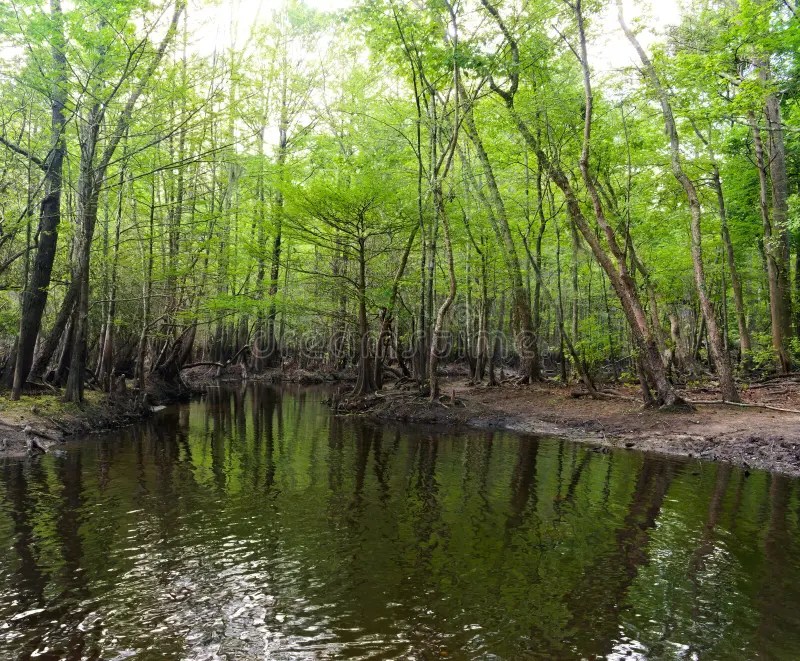
Key analytic point: Ecological connectivity and legal connectivity are not the same thing. A wetland can be seasonally connected, biologically critical, and socially valuable while still falling outside a narrowed jurisdictional definition.
A1
Historical background: before and after the Clean Water Act
Pre-Clean Water Act
Long before modern conservation law, wetlands in the United States were widely viewed as land to be converted. Drainage districts, agricultural expansion, flood-control engineering, forestry alteration, and development all contributed to large-scale wetland loss. An NC State Extension review notes that wetland losses in the United States were especially severe from the 1950s through the 1980s, with the Southeast bearing much of the decline; North Carolina mirrored that broader trend, including the loss of 1.2 million acres during one especially severe period from the mid-1970s to mid-1980s.5
Passage of the Clean Water Act
The 1972 Clean Water Act changed the legal landscape by establishing federal jurisdiction over “navigable waters,” defined in the statute as “waters of the United States.” That threshold term matters because several major Clean Water Act programs apply only within that jurisdictional scope.1 Over time, federal agencies and courts interpreted that scope through an evolving set of rules, guidance documents, and judicial opinions. The result was never a perfectly stable system, but for many years protection could extend beyond only those waters with an obvious, permanent, surface-visible connection.
Why definition became the battleground
Wetland regulation became a contest over definition. Which waters count? Which wetlands are adjacent enough? What counts as a significant ecological connection? These legal tests mattered because the broader the jurisdiction, the more wetlands could trigger permitting and review. The narrower the jurisdiction, the easier it became for ecologically meaningful wetlands to fall through regulatory gaps.
Large-scale wetland drainage and conversion.
Clean Water Act resets the legal framework.
Jurisdictional definitions remain contested and unstable.
Sackett and state alignment narrow protection further.
A2
Federal developments after Sackett
Introduce the case
In 2023, the U.S. Supreme Court in Sackett v. EPA narrowed the scope of Clean Water Act jurisdiction over wetlands. EPA summarizes the resulting standard as requiring a continuous surface connection that makes it difficult to determine where the water ends and the wetland begins.1 Whatever one thinks of the legal reasoning, the ecological implication is straightforward: some wetlands that matter biologically and hydrologically are no longer protected merely because they do not satisfy a narrower legal test.
Why the shift matters
The consequence is not simply legal tidiness. It is a changed threshold for protection. Wetlands that remain real in ecological terms may no longer count in regulatory terms, and that distinction determines whether they receive review, mitigation, or effective safeguards.
Developments since then
Federal agencies issued a conforming rule after the decision. States were then left to decide whether they would maintain stronger state-level protections, accept a narrower floor, or attempt some middle path. North Carolina moved toward alignment with the narrowed federal definition rather than toward independent expansion of protection.2
B1
Wetland protection in North Carolina
Why North Carolina is the critical case
North Carolina is especially important to this conversation because its wetland landscapes are varied, ecologically rich, and politically vulnerable. Coastal wetlands, pocosins, Carolina bays, depressional wetlands, and forested wetland systems contribute to biodiversity support, hydrologic moderation, nutrient retention, and storm resilience. Yet state policy has not always treated these functions as grounds for strong independent protection.
A 2026–2030 draft coastal strategy document prepared through NCDEQ and the Division of Coastal Management later summarized the effect plainly: North Carolina aligned its definition with the federal definition, reducing protection for isolated and non-404 jurisdictional wetlands; according to EPA, around 30,000 isolated wetlands in the state no longer have protection.3
Advocacy groups have argued that these losses are not just symbolic or procedural. In a 2023 press release, the Southern Environmental Law Center contended that the state legislature’s rollback increased flood risks and endangered communities and fisheries, and cited an internal analysis suggesting that about 900,000 acres in the Neuse and Cape Fear basins alone were now at risk of pollution and destruction.6
Policy failures and enforcement gaps
The conservation challenge is therefore cumulative. Federal narrowing reduces one layer of protection; state alignment reduces another; and limited mapping, uneven enforcement, and development pressure do the rest. North Carolina’s wetland vulnerability is a governance problem as much as a habitat problem.
B2
Why wetlands matter ecologically
Hydrology and flood buffering
Wetlands slow, store, and redistribute water across landscapes, helping reduce flood peaks and downstream damage.
Habitat and amphibian diversity
Small and seasonal wetlands can be disproportionately important for breeding habitat, especially in a state rich in amphibian diversity.
Landscape identity
Pocosins, bays, marshes, and swamps are not peripheral spaces; they are part of North Carolina’s ecological character.
C1
Conservation solutions & strategies
Restore stronger state-level wetland protections
What it is: Rebuild state authority to protect isolated and other vulnerable wetlands that now fall outside narrowed federal jurisdiction.
Why it matters: The regulatory gap is now a state problem.
Strengths: Direct, structural, scalable.
Limitations: Politically difficult and dependent on enforcement capacity.
Expand wetland mapping, monitoring, and public visibility
What it is: Improve statewide mapping, citizen-facing tools, and ecological monitoring so vulnerable wetlands are harder to ignore or reclassify as expendable.
Why it matters: Better visibility supports public education, planning, and stronger conservation arguments.
Strengths: Politically achievable, useful for research and teaching.
Limitations: Mapping alone does not create protection.
Target restoration and community-based conservation
What it is: Pair restoration projects, conservation easements, and watershed-based advocacy with community-facing messaging.
Why it matters: Wetland conservation becomes more durable when people can see flood, habitat, and quality-of-life benefits clearly.
Strengths: Builds coalitions and creates visible wins.
Limitations: Patchwork restoration cannot substitute for baseline protection.
This is the point where the argument shifts from description to evaluation: the question is no longer only what happened, but what kind of conservation response is actually plausible under current legal and political conditions.
C2
Future outlook
Prognosis
If current trends continue, North Carolina will likely face a landscape in which the most easily overlooked wetlands become the most easily lost. The trajectory is not merely one of acreage decline; it is also one of diminished function, increased fragmentation, and reduced resilience in the face of climate-driven storms, flooding, and development pressure.
Recommendations
- Adopt stronger state-level definitions and permitting standards that explicitly protect isolated and ecologically significant wetlands.
- Integrate wetland mapping, amphibian-sensitive habitat assessment, and restoration priorities into local and regional planning rather than treating wetlands as isolated permit questions.
Where this leaves the argument
The policy future of North Carolina wetlands depends on whether the state treats them as hydrologically and ecologically meaningful systems or as expendable edges of developable land.
Visual summary
How protection narrowed
Broader protection framework
Before the 2023 narrowing
- More expansive federal interpretation
- Greater room for ecologically connected wetlands
- Stronger baseline permitting reach
Current vulnerability
After Sackett and NC alignment
- Narrower federal definition
- Reduced protection for isolated and non-404 wetlands
- Greater dependence on state action
Why this matters next: Once the federal floor narrowed, the crucial question became whether North Carolina would preserve stronger protections or follow the narrower standard.
Resources
Citations & selected source notes
Policy critique
6. Southern Environmental Law Center
North Carolina legislature’s elimination of wetlands protections increases flood risks and endangers communities and fisheries (2023).
Advocacy-oriented source, but useful for understanding how the rollback was framed in terms of flood risk, fisheries, and community vulnerability.
1. U.S. Environmental Protection Agency
About Waters of the United States. Useful for explaining the legal threshold term and the post-2023 federal shift.
 North Carolina Wetlands At Risk